
5 Yoga Poses for Desk Workers in the Raleigh-Durham Triangle
Practical desk-worker yoga: 5 poses you can do at your desk or in 10 minutes at home to undo the tightness of long hours at a keyboard. Written for office workers in the Triangle Area.
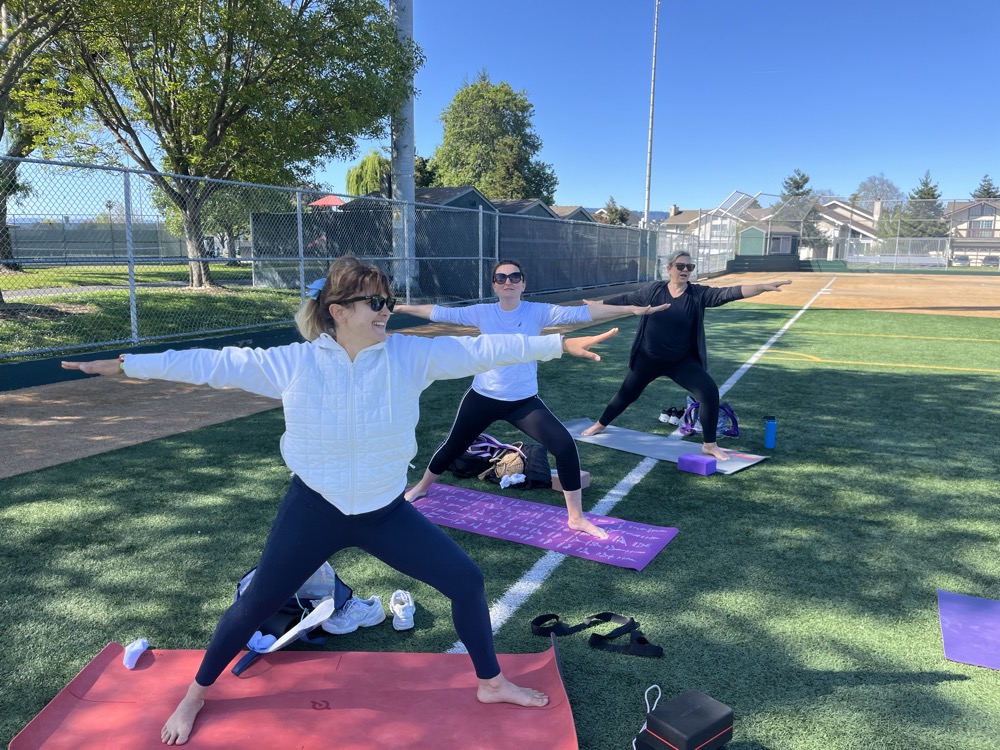
The Triangle is full of desks. Research Triangle Park alone has thousands of people who spend six to ten hours a day staring at a monitor, shoulders rounded forward, neck pushed slightly out, hips locked at ninety degrees. Multiply that by the years and you get the body most of my corporate yoga students walk in with.
The good news: a lot of that tightness is reversible with ten minutes a day of the right movements. Not heroic flexibility. Not yoga-Instagram poses. Five small, honest practices you can do at your desk or on the floor next to it.
Here are the five I prescribe most often, in order of importance.
1. Seated cat-cow (90 seconds)
What it does: Wakes up the spine. The mid-back stiffens first when you sit, and it stiffens silently — you do not notice it until you try to look over your shoulder while backing out of a parking space and feel a small electric no.
How:
- Sit on the front edge of your chair, feet flat on the floor, hands on your thighs.
- Inhale. Lift your chest forward and up. Let your shoulders roll back. Look slightly toward the ceiling. This is cow.
- Exhale. Round your back like a cat. Tuck your chin gently. Pull your belly in. Feel your upper back spread.
- Repeat ten breaths, slowly.
This is the single highest-return movement for office bodies. Do it twice a day for two weeks and you will feel the difference in how your neck holds up during long meetings.
2. Doorway chest opener (60 seconds per side)
What it does: Counters the rounded-forward shoulder position that comes from typing. Your pectoral muscles shorten when your arms reach forward all day; lengthening them once a day prevents the upper-back ache that most knowledge workers carry by Wednesday afternoon.
How:
- Stand in a doorway. Bend your right elbow to ninety degrees and place your forearm against the doorframe, fingers pointing up.
- Step your right foot through the doorway. Keep your forearm pressing into the frame.
- Gently turn your chest away from the doorway until you feel a stretch across the front of your right shoulder and chest. Stop before it pinches.
- Breathe for thirty to sixty seconds. Switch sides.
If you only have time for one stretch all day, this is the one. It also undoes the small habits of holding a phone, holding a steering wheel, and holding a baby on one hip.
3. Hip flexor lunge (60 seconds per side)
What it does: Your hip flexors — the muscles at the front of your hips — shorten dramatically from sitting. Tight hip flexors pull on your low back. Most of the chronic my low back is killing me you hear from office workers is actually a hip-flexor problem in disguise.
How:
- Step your right foot forward into a lunge, left knee on the floor (use a folded towel if you need cushion).
- Tuck your tailbone slightly under, like you are zipping up tight jeans.
- Lean your hips gently forward. You should feel a stretch at the very front of your left hip.
- Breathe slowly for thirty to sixty seconds. Switch sides.
If you take a one-hour lunch break, doing this once during your break is worth more than another thirty minutes at your desk.
4. Wrist circles and forearm stretch (90 seconds)
What it does: Your wrists, forearms, and the small muscles in your hands take a beating from keyboards and trackpads. Most desk workers ignore them until they feel a twinge. Do not wait for the twinge.
How:
- Extend your right arm in front of you, palm down.
- Use your left hand to gently pull the back of your right hand downward and toward your body. Stretch the top of the forearm.
- Flip the right hand palm-up. Use your left hand to pull the fingers gently back toward your body. Stretch the underside of the forearm.
- Hold each for fifteen to twenty seconds. Switch arms. Finish with ten slow wrist circles in each direction.
This is the cheapest carpal-tunnel insurance you can buy.
5. Legs up the wall (5–10 minutes)
What it does: Drains the legs, relaxes the nervous system, lowers blood pressure, helps you sleep. The single most restorative pose for someone who has spent the day in a chair.
How:
- Lie on your back next to a wall.
- Swing your legs up so they rest vertically against the wall. Your back stays on the floor. Your tailbone can be a few inches from the wall — find a comfortable distance.
- Arms rest gently at your sides. Eyes can close.
- Stay for five to ten minutes. Breathe.
Five minutes here at the end of a workday is better than a glass of wine. I will not say it more strongly than that, but it is true.
Putting it together: a 10-minute end-of-workday sequence
If you have ten minutes and want a single ritual:
- Seated cat-cow — 90 seconds
- Doorway chest opener — 60 seconds each side (120 seconds)
- Hip flexor lunge — 60 seconds each side (120 seconds)
- Wrist stretches — 90 seconds
- Legs up the wall — remaining 4–5 minutes
Done at 5:30 PM, this sequence costs you ten minutes and gives back two hours of evening you would otherwise have spent feeling stiff and irritable.
When to bring it to the office
If you work in an office where two or three of you are already doing some version of this at your desks, you have the makings of a small corporate yoga program. I run forty-five to sixty-minute sessions for teams across the Triangle — Apex, Cary, Morrisville, Durham, Raleigh, and the RTP campuses. No special equipment. No spandex required. Most sessions happen in a conference room or open floor space.
Sometimes the easiest way to make these practices stick is to schedule them once a week with a teacher who shows up at the office. If that sounds useful for your team, send me a message — I am happy to put together a proposal.
Until then: cat-cow, twice a day, for two weeks. That is the experiment. Tell me how it goes.
— Gizem